
Alumni
Ian Hislop (1977) reflects on his journey after Ardingly


Ian Hislop (1977) – journalist, satirist, writer, broadcaster, historian – became editor of Private Eye 40 years ago. This work anniversary provided the perfect excuse to chat to the man himself and delve into the College Archive to discover just how much of his career can be traced back to his time at Ardingly. Most of it, it turns out. “It was a direct line from the Martlet.”
Ian arrived at Ardingly in 1968 and joined Miss Krailing’s class in the Junior School. “She took the first intake, when you’re the smallest in the school, and she was absolutely fabulous.” Her impact as a teacher was profound. “I was in a class with four other boys who exactly ten years later all got into Oxbridge. It would suggest she gave us the right start!”


As well as the academic grounding, Miss Krailing inspired a love of literature, particularly the myths and legends of the ancient world. “As a treat she used to read us extracts from the Odyssey, which we genuinely looked forward to… When I went to see the Christopher Nolan film, I thought, I’ve known this my entire life. She was brilliant.”
From writer to editor
Flick through the Martlet from the early 1970s and it is full of creative writing and poetry, much of it by I D Hislop. Again we see the influence of Miss Krailing, the Martlet’s new editor. “Miss Krailing has plans for radical changes… it is hoped, for instance, that a much higher proportion of the contributions will come from the boys themselves.” Ian certainly made the most of this opportunity, and the chance to write and see his work in print was step one towards the Eye: “It is perhaps no surprise that I ended up running a magazine, given I’d spent quite a lot of time at school from the age of eight contributing to and helping run the Martlet.”

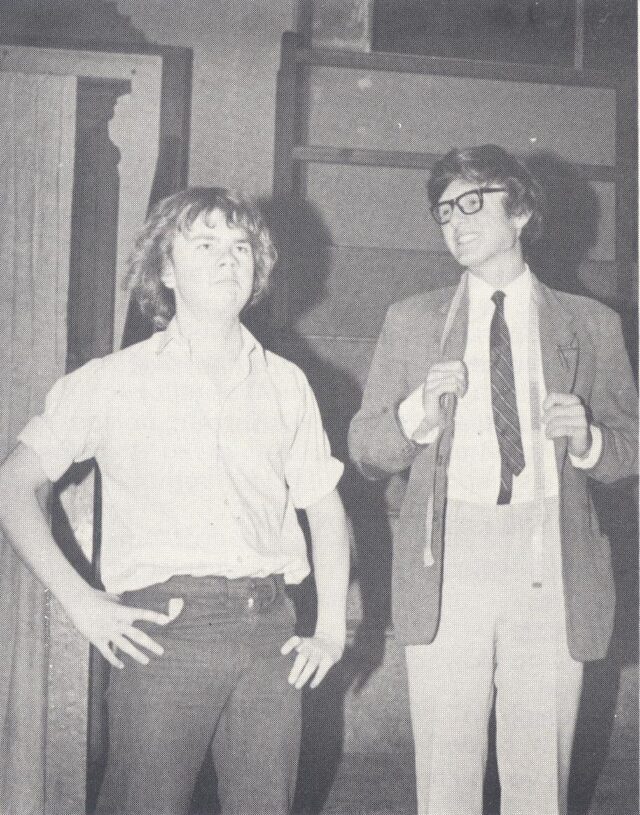
Play reports are another feature of the Martlet and these performances are core memories for Ian. “I remember doing Androcles and the Lion. It was the first time I got a really big laugh.” The review in the Martlet describes David Wight’s (1976) Androcles – “the meek and humble husband” – and Adam Blackwood (1977) as the “ferocious, domineering wife.” It continues: “I for one shall always remember ‘little’ Ian Hislop strutting on to the stage with many a bold threat and demand.” Ian recalls, “I had two lines as an ox driver. I literally had to say, ‘Hey you soldiers, get out of the way for the Emperor.’ And I got a laugh! And I thought, this is good, this is fun, I might do more of this.”
There were more laughs in store as Mrs Sowerberry, the sour undertaker’s wife, in a production of Oliver! Writing in the Martlet, Ian described his costume – green dress, plenty of padding, blue petticoat, ridiculous wig – remarking that he did not mind the mockery, as “The play came off and it was all good for a laugh.” His final Junior School role was Mr Pond, “a rather muddled, and eventually much harassed” headmaster in The Happiest Days of Your Life. The Martlet concluded that “the authority of a headmaster seemed to come quite naturally to him.”


Junior School also gave Ian his first taste of debating, an early lesson in how to make a compelling point and craft an argument. The Martlet tells us that in 1972 they discussed the “weighty matter of co-education” at the College. In favour was Miss Krailing “ably assisted by Ian Hislop” with Mr Hayes and Neil Gaiman (JS 1974) in opposition. Recalling the debate more than 50 years later, Ian remembers “making some points and thinking, oh, that’s fun, that’s landed.” The motion was carried by 46 votes to 36. “And there’s Miss Krailing featuring again. I was incredibly lucky in terms of the teachers I had.”
Ian moved to the Senior School in September 1973. Writing in the Times Educational Supplement 20 years later, Ian summed up the setting: “It wasn’t exactly luxurious. There were 35 people in a dormitory (and no curtains) and the food was pretty terrible. I suppose it was a fairly standard non-comfortable public school but I was happy there.” His happiness had a lot to do with Colin Temblett-Wood. “He was a brilliant man… very funny, a great enthusiast and interested in the things that I found interesting”
The fearless teacher
Many people are lucky enough to remember an inspirational teacher. For Ian, Temblett-Wood was undoubtedly that teacher. “He managed to make us believe we could achieve most things in the present and almost anything in the future.” Looking back now, from the vantage point of some five decades, Ian remains crystal clear on his impact: “Temblett-Wood was the single greatest influence.”
Ian’s Tutor as well as his English teacher, Temblett-Wood also directed plays. “He made being in the play the most exciting experience. So much so that it could explain anything. If you were caught at two o-clock in the morning wandering around the corridors with a bottle of cider and were asked what you were doing you just said, ‘We’re in the play.’ Oh yes, of course… The play. We’re in the play – fine.
There was a great sense of questioning, of scepticism, of being allowed to find it funny. That’s the basis of my career.”
Ardingly in the 1960s still seemed somewhat Edwardian, but Ardingly in the 1970s had clocked – or was beginning to clock – wider changes in society. Temblett-Wood was part of that process. “Temblett put on the play about the Peterloo Massacre. It’s about a left-wing orator drawing a vast crowd of people to try and get some sort of social change in Britain and they send in the dragoons and massacre them. It was a very earnest play and for Ardingly it was a very left-wing perspective, and the school just sniggered and laughed. The opening night looked like it was getting out of hand and Temblett came on stage, stopped the play, looked the school in the eye and shouted, ‘You arrogant public school bastards!’ That is exactly what he said. And it was a fabulous moment. And then we restarted the play and it was terrific. He was an extraordinary presence. Fearless.”
Temblett-Wood encouraged his pupils to pursue their own ideas and run their own projects. He was there in the background, making sure there were no disasters, but he gave them the permission, freedom and confidence to try things. The Annals is an obvious example. Edited by the same teacher, Mr Coghlin, from 1936 to 1963, Temblett-Wood is listed as the editor for one issue only before a succession of student editors take over. “Nick Newman and Simon Parke were first, so by the time I was sort of getting there, we knew we were allowed to do it. I was always keen to write stuff that was funny. There was always scope for parody and comic writing. Nick could draw beautifully even at that age, and David Wight too. There was an enormous amount of talent about, looking back on it.”
A sketch show in the making
As well as the Annals, Ian and his friends also wrote and performed their own revues, again with the encouragement of Temblett-Wood. One of the programmes is in the Archive, so we can see the range of songs and sketches they performed. There was even dancing from the “REJECTIONS – The up-and-coming dance group.” Another item, “NATIONSNIDE – Current affairs compiled and presented by Simon Marriner and Ian Hisop”, neatly foreshadows Ian’s parallel career as one of the captains on Have I Got News For You, the BBC’s long-running satirical panel show.

Perhaps surprisingly, these performances were enjoyed by the Headmaster, Christopher Bulteel, as much as by the students. “He allowed us to get away with a lot… He’d been a monk and got an MC in the war, so he wasn’t exactly short of either commitment or patriotism, but he always found what we did funny.” Even when the jokes were directed close to home: “I remember him sitting in the front row at the first night of one of these shows, rocking with laughter at a sketch about the feebleness of careers masters and the importance of joining the armed forces in order to become a public-school bursar later in life.”
Clearly the urge to poke fun at authority and puncture pomposity was firmly established during Ian’s time at Ardingly. “You think, gosh, it’s all the CCF and the scout troop, but actually there was a great sense of questioning, of scepticism, of being allowed to find it funny. That’s the basis of my career. As I tell people, I am not cynical, I am sceptical. I believe in lots of things, but I question things. That’s what teachers like Temblett and Geoffrey Boxall allowed you to do.”
The friends I made at Ardingly are still my friends.”
The 1977 Annals incudes a write up from that year’s OA Society Dinner: “Ian Hislop, the Head Prefect, and one renowned for his confidence and wit, seconded the response made by the Headmaster…” Did that confidence evolve during Ian’s time at Ardingly, or did he arrive with it fully formed? “I think I was probably quite a bumptious child anyway. But it was certainly sort of tolerated and encouraged,” he laughs.
“I remember giving the speech at what we used to call Head’s Guts, the Christmas feast, which was a huge all-school function. They were always threatening to cancel it if the school didn’t behave or if no one owned up for some particular offence but no one ever believed them because it was far too much fun. I did the speech at that – probably my first after dinner! – and then I basically repeated that speech at the Old Boys thing. I remember thinking, this is possible. It was that feeling of, I can do this.”
Friendships that last a lifetime
Ian’s Ardingly comes across as tremendous fun. “We organised a huge bicycle Rolla Ball event and commentated from the top of the chapel with a loudspeaker system… We’d organise sing-songs with boys standing on landings singing Jerusalem in the dead of night for no reason at all.” And, of course, running through it all are the friendships: “The friends I made at Ardingly are still my friends.”
From Ardingly, Ian went to Oxford, following in the footsteps of one of those friends, Nick Newman (1976). Another factor was the chance to work on Passing Wind, the satirical magazine Nick had set up with Simon Parke (1975), which they had taken with them to Oxford. “Chris Potter [Ian’s Housemaster] took a group of us on a tour of Cambridge and said, ‘This is my old university, you must come here.’ And I remember thinking, no, I’m going to Oxford!”
When Ian got there, Nick sold him Passing Wind. “I had to take its debts on board. I needed 400 quid to buy the back copies and pay off what was owed. I didn’t have 400 quid but my tutorial partner was a delightful Old Etonian, so I thought I’d ask him.” The Old Etonian helpfully obliged, and Ian duly had the money to purchase the magazine. “I paid him back, with interest.”
Ian studied English, and although a lot of his time was spent running the magazine and putting on revues, he also made the most of the opportunity to read every single author that had ever written anything funny. “I read Dryden and Pope. I read Swift. I read Bernard Shaw. I read Oscar Wilde. I read Dickens. I was just allowed to drink at this very British fountain of satirical tradition for three years. You mustn’t say this to young people now, I know, but I got paid to do it. There’s no wonder they’re cross with us.”
An eye on the Eye
Fast forward three years, and with his degree completed, he thought, “How can I carry on doing magazines and shows and making people laugh? Can I make a living out of it?” He had in fact started writing at Private Eye before his time at Oxford was even over – “I got my first piece in Private Eye just before my finals” – so it didn’t take long for that question to be answered: he went straight from Oxford to the Eye, an unbroken line from the Martlet.
In 1986, just three years later, Richard Ingrams, Ian’s predecessor at the Eye, decided it was time to go. “He instituted a full recruitment process. He called me into his office and asked me if I wanted to be editor.” Ian knew what he had to do: be funny, be satirical, run solid journalistic pieces. He made his mark quickly with a number of crucial hires. Journalists Paul Foot and Francis Wheen joined the team and, “on the jokes side, I looked around pretty comprehensively and chose Nick Newman.”

When asked by earnest academics whether Private Eye has a mission statement, Ian likes to tell them: “It’s from the great English philosopher, Mary Poppins, who said, ‘A spoonful of sugar helps the medicine go down’. And that really is what the Eye is doing.” Put simply, “The
Eye is two things: it’s jokes and it’s journalism. They feed off each other but it’s a strange publication in that you get both. We try and tell you what you don’t know and then we make jokes about it the week after because then you do know.”
Jonathan Swift, one of Ian’s satirical heroes, said “the chief end in all my labours is to vex the world rather than divert it.” Three centuries later, the Eye continues that rich tradition of satire – the jokes have purpose. Challenging hypocrisy, holding power to account, channelling outrage: “That’s the thing you can do with campaigning journalism. You can be the megaphone to the campaigners.” Looking back over 40 years, one campaign in particular stands out. “At the moment I would just say the post office. The biggest miscarriage of justice, every single institution failing and technology at the heart of it – people believing that the computer must be right, whereas in fact the computer shafted all of them.”
We don’t have AI here at the Eye and we’re not going to.”
One change over the forty years has been a shift from breaking stories to challenging the flood of disinformation. “Now it’s about explaining why stories aren’t true. There is so much false information out there.” Ian’s message to the current generation of Ardingly students is clear: scepticism is even more important than ever. “They’re getting fed more things that they should question from their own peer groups and from social media. I think the single most important thing they should do is look at what’s being shoved their way and think is this true? Is this in any way helpful? Is any of this right? Why should I listen to these people?”
He is also scathing about AI. “The idea that you would relinquish one of the great human abilities, which is to converse and write and convince and entertain, and let a machine do it. It’s mind boggling to me. Why would you? It’s totally pointless. The idea that you can get AI to summarise an argument for you. Well, then you haven’t taken the argument on board. Get AI to write your proposal. Well, then it’s no longer yours. We don’t have AI here at the Eye and we’re not going to.”
So, after 40 years, does Ian have any plans to retire? “No, absolutely not. I’ve got a number of really great jobs. If I’m sacked, that’s fine, but I’m not going voluntarily!” He is optimistic about the future of print – “we’re selling 220,000 now, on a good week 230,000, more than we were selling in 2001” – and the need for satirists to hold power to account is more acute than ever. “That is the point. I still think it’s worth it.”


